
Embedded What?
While structured products can take many shapes, all of them consist of ‘embedded’ options in some form. By embedded we mean that these options are an innate part of the product that users can enjoy, but without requiring an explicit mastery of how they work individually.
Think of these embedded options as add-on features with your new fancy car (bull market right?) — things such as memory seats, surround systems, or parking assists that you enjoy as part of the entire vehicle you purchased. Just as these add-on features help to enhance your driving experience, embedded options create tailored outcomes that best suit your risk tolerance.
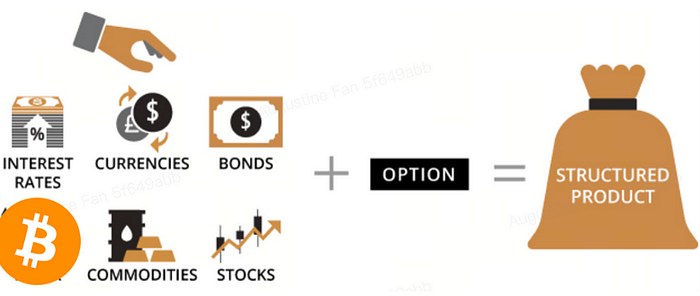
On SOFA’s structured products, to generate those cool payoff diagrams you see, one is basically playing structuring Lego by buying or selling different groups of options against your principal deposit. Don’t worry, just as you might not understand how ABS-braking works to keep you from skidding, SOFA’s structured products are designed to ‘just work’, so you can enjoy the scenario-driven payoffs without stressing over the details. Couch potato for the win!
Free Lunch & Airdrops
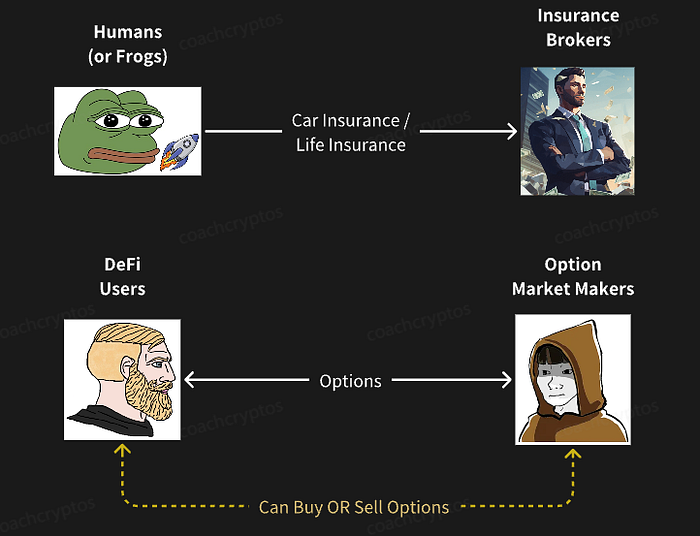
Obviously, nothing in life comes for free, so these options (like car features) have a cost to them. Are we going to go into options price models now? I thought we were here to chill on SOFA. Don’t worry, we are not going to get into specifics, so just think of options as insurance you can buy on your car / house / health, and the money you pay to your favorite brokers are known as ‘premium’. Guess what? Option costs are called ‘premiums’ too! And instead of insurance brokers, your market makers are your counterparties. So far so good right?
So why did we bother with all this? Let me re-phrase myself and say that sometimes there IS a free lunch, and in SOFA that is called RCH airdrops. Recall that RCH is our utility token and is exclusively rewarded to our protocol users, on-top of the structured product yields they are getting. Yes, go-ahead, have your cake and eat it too, that’s kind of the whole idea.
Furthermore — now that I have your attention — recall that our daily airdrop numbers are permanently fixed from day 1, but the % of tokens allocated to our users are proportional to their executed premium versus the daily total. In formula terms (the only one, I promise), it’s expressed as:

Trade More, Get More?
So moral of the story is, the more you trade, the more the free lunch right? Yes, but not quite. Specifically, it should be the more option premium you trade versus everyone else, the more RCH you are entitled to.
But but but… how do I know how much option premium is embedded per structured product? Well… you asked for it, not me! As a TL;DR approximation (please DM the math team at SOFA if you want to work out the details):
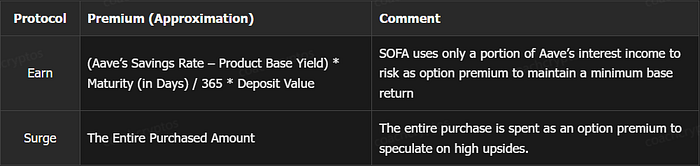
As you can see, for the same deposit amount, Surge products account for a much higher ‘premium’ weight, which is 100% reasonable since you are risking the entire deposit as speculation. As an attempt to incentivize activities across both protocols, our sensitive readers would have noticed a [Vault Weight] at the end of the formula. The [Vault Weight] is currently set as [50] for Earn, and [1] for Surge, in an attempt to balance out reward incentives during our initial launch.
Finally, as SOFA grows and additional protocols come in, you can appreciate how important this variable will be in driving TVL, and this is going to be one of the vital parameters that can be voted on by our $SOFA governance tokens.
Check Out Our Docs!
Say what… what governance tokens? Tsk tsk, you really should have read our gitbook docs here. But anyhow, that’s enough for today, and we shall cover the innovative logic behind SOFA’s dual token model in a separate Deep Dive series.
LFG fellow friends and couch potatoes! Time to earn some yield (and a free lunch)!